
Modern finance teams face increasing pressure to deliver accurate, timely, and transparent financial reports. Managing multiple systems, subsidiaries, and data sources often makes relying solely on spreadsheets a bottleneck that raises the risk of errors.
LiveFlow has become a popular solution for connecting accounting systems to Excel and Google Sheets, enabling real-time updates and live reporting.
While it excels at offering a spreadsheet-first approach, some organizations need deeper financial close automation, structured workflows, and reconciliation management that goes beyond simply pulling data into Sheets.
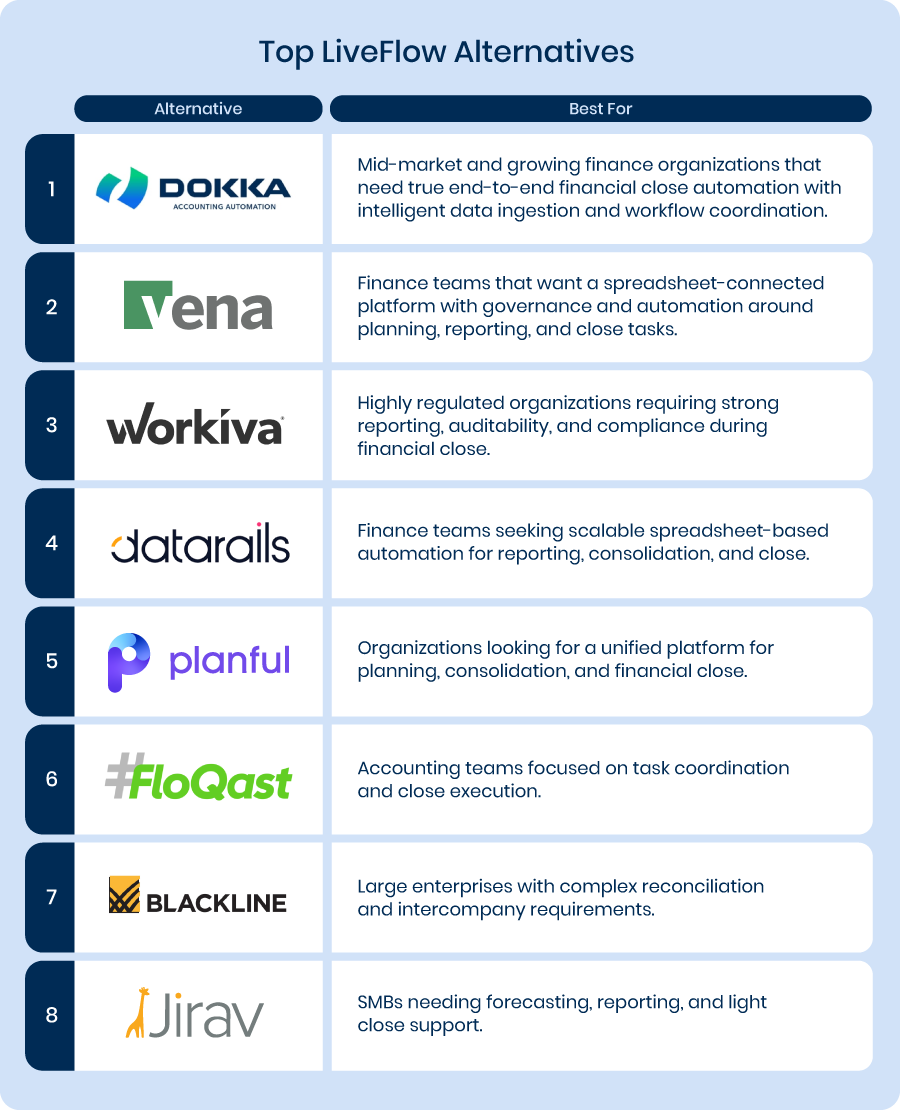
Below are the 8 best LiveFlow alternatives, each offering distinct strengths depending on your organization’s size, complexity, and automation goals.
8 Best LiveFlow Alternatives For Financial Close Automation
- DOKKA
- Vena
- Workiva
- Datarails
- Planful
- Floqast
- Blackline
- Jirav
1) DOKKA
Best For:
Mid-market and growing finance teams seeking end-to-end financial close automation with intelligent data ingestion and workflow orchestration.
Overview:
DOKKA is a modern financial close automation platform designed to eliminate manual work across reconciliations, journal entries, close task tracking, and reporting.
Instead of relying on spreadsheets as the core operating layer, DOKKA centralizes close activities in a single system with real-time visibility. Its AI-driven capabilities help finance teams proactively identify exceptions and bottlenecks, enabling faster and more predictable closes.
Key Features:
- AI-powered data capture and automated GL reconciliations
- Automated journal entries and approval workflows
- Close checklists, task orchestration, and audit trails
- Integrations with major ERPs
- Real-time dashboards for close status and exceptions
Why It’s a Good Alternative to LiveFlow:
LiveFlow focuses on streaming financial data into spreadsheets, while DOKKA goes further by automating the operational mechanics of the close itself.
Instead of relying on manual spreadsheet controls, DOKKA provides built-in workflows, validations, and audit trails that reduce risk and manual oversight. These capabilities make DOKKA better suited for teams looking to scale close operations without increasing headcount.
Setup Process:
DOKKA offers a guided onboarding process that includes ERP integration, workflow configuration, and close checklist setup. Most customers become fully operational within weeks, allowing teams to realize value quickly without long implementation cycles.
G2 Customer Reviews:
Users frequently highlight faster close cycles, reduced reconciliation effort, and improved visibility into close progress. Many also praise DOKKA’s intuitive interface and responsive customer support, noting how quickly teams adopt the platform.
2) Vena
Best For:
Finance teams that want spreadsheet-connected workflows with stronger governance for planning and close processes.
Overview:
Vena combines Excel familiarity with centralized data management and workflow controls.
The platform supports both FP&A and financial close activities, allowing teams to continue working in spreadsheets while improving consistency and oversight. The hybrid approach appeals to organizations that want structure without abandoning Excel.
Key Features:
- Excel-native interface with centralized data
- Close cycle task coordination
- Budgeting, forecasting, and planning modules
- Real-time dashboards and reporting
- ERP and data source integrations
Why It’s a Good Alternative to LiveFlow:
LiveFlow focuses primarily on live data connections, while Vena adds workflow controls and governance on top of spreadsheet-based processes.
The added structure makes Vena more suitable for organizations that want spreadsheet flexibility but require stronger approval workflows and more coordinated close processes.
Setup Process:
Vena implementations typically involve building standardized templates, defining workflows, and connecting data sources. The onboarding process is collaborative and helps teams align the platform with existing financial models.
G2 Customer Reviews:
Customers appreciate Vena’s balance between flexibility and control. Many report improved consistency in close and planning cycles while maintaining the Excel experience their teams prefer.
3) Workiva
Best For:
Highly regulated organizations requiring strong reporting, auditability, and compliance during financial close.
Overview:
Workiva is a connected reporting platform that links financial data, narratives, and controls across teams. It is widely used for financial reporting, SEC filings, and audit documentation, helping organizations maintain consistency across disclosures.
The platform emphasizes traceability and collaboration across departments.
Key Features:
- Connected reporting with live data linking
- Compliance and audit documentation support
- Workflow automation and version control
- Cross-team collaboration tools
- ERP and data source integrations
Why It’s a Good Alternative to LiveFlow:
Workiva focuses on governance and audit readiness, while LiveFlow primarily targets spreadsheet reporting efficiency. For teams operating in regulated environments, Workiva provides stronger controls, version tracking, and documentation capabilities throughout the close process.
Setup Process:
Onboarding involves configuring data connections, reporting templates, and user permissions. Teams also receive guidance to align workflows with compliance and audit requirements.
G2 Customer Reviews:
Users often highlight improved transparency and confidence in reporting accuracy. Many also appreciate Workiva’s collaboration features, which help reduce last-minute reporting errors.
4) Datarails
Best For:
Finance teams seeking scalable spreadsheet-based automation for reporting, consolidation, and close.
Overview:
Datarails centralizes financial data while preserving spreadsheet workflows for reporting and analysis. It pulls data from ERPs into a controlled backend, allowing teams to build live, consolidated reports without relying on fragile manual formulas.
Growing organizations moving away from fully manual spreadsheets find this particularly useful.
Key Features:
- Centralized financial data repository
- Automated consolidation and reporting
- Excel integration
- Close and FP&A templates
- KPI dashboards
Why It’s a Good Alternative to LiveFlow:
Datarails works closely with spreadsheets like LiveFlow, but it offers a more structured and scalable backend. This approach reduces spreadsheet risk and makes consolidation more reliable as data volume and complexity increase.
Setup Process:
The setup involves connecting data sources, defining consolidation rules, and creating standardized reporting templates. Teams can gradually migrate existing spreadsheets into the platform.
G2 Customer Reviews:
Users report improved accuracy and reduced manual effort in reporting. Many value the ability to continue working in Excel while benefiting from automation.
5) Planful
Best For:
Organizations looking for a unified platform for planning, consolidation, and financial close.
Overview:
Planful delivers cloud-based close automation along with planning, forecasting, and reporting. It replaces fragmented spreadsheet workflows with a centralized system designed to support multi-entity consolidation and structured financial processes.
Key Features:
- Close and consolidation management
- Budgeting and forecasting
- Workflow automation
- Role-based dashboards
- ERP integrations
Why It’s a Good Alternative to LiveFlow:
Planful provides deeper automation and governance than LiveFlow, managing close and consolidation directly within the platform. It is well suited for organizations aiming to standardize close processes across entities.
Setup Process:
Implementation involves consolidation modeling, workflow design, and reporting setup. Planful’s team collaborates closely with customers to align the platform with their financial calendar.
G2 Customer Reviews:
Users report improved coordination between planning and close activities. Many also emphasize enhanced visibility into consolidated results.
6) FloQast
Best For:
Accounting teams focused on task coordination and close execution.
Overview:
FloQast is a close management platform built around checklists, reconciliations, and collaboration. It helps teams track tasks, document progress, and maintain accountability throughout the close.
Key Features:
- Close checklists and task ownership
- Reconciliation tracking
- ERP and file storage integrations
- Collaboration tools
- Close progress reporting
Why It’s a Good Alternative to LiveFlow:
FloQast focuses on managing the close workflow itself rather than just financial data movement. Teams struggling with task coordination and close accountability find it especially effective.
Setup Process:
Configuration involves mapping close tasks, assigning owners, and integrating accounting systems. Teams can typically start using FloQast quickly.
G2 Customer Reviews:
Users report clearer ownership and faster close cycles. Many highlight the transparency FloQast brings to month-end processes.
7) BlackLine
Best For:
Large enterprises with complex reconciliation and intercompany requirements.
Overview:
BlackLine is a market leader in financial close automation, offering advanced reconciliation, journal entry, and intercompany accounting capabilities. It is designed for organizations with high transaction volumes and strict control requirements.
Key Features:
- Automated reconciliations
- Intercompany accounting
- Journal entry automation
- Close task orchestration
- Audit trails
Why It’s a Good Alternative to LiveFlow:
BlackLine delivers deep operational automation that goes well beyond spreadsheet synchronization. It suits organizations requiring enterprise-grade controls and compliance throughout the close process.
Setup Process:
Implementation involves ERP integration, rule configuration, and workflow design. The process is more involved but supports complex accounting environments.
G2 Customer Reviews:
Users highlight scalability and strong reconciliation accuracy. Many also report improved audit readiness.
8) Jirav
Best For:
SMBs needing forecasting, reporting, and light close support.
Overview:
Jirav provides driver-based planning, forecasting, and reporting with basic consolidation capabilities. It is designed for smaller teams seeking insight without heavy enterprise complexity.
Key Features:
- Driver-based forecasting
- Scenario planning
- Financial dashboards
- Accounting integrations
- Consolidated reporting
Why It’s a Good Alternative to LiveFlow:
Jirav delivers broader planning and analytical capabilities than LiveFlow, enabling teams to move beyond reporting and gain forward-looking financial insight.
Setup Process:
Setup generally involves connecting accounting systems and configuring models. Teams can be up and running quickly.
G2 Customer Reviews:
Users appreciate Jirav’s simplicity and visualization tools. Many report that it helps them better understand financial drivers.
Why DOKKA Is the Best LiveFlow Alternative in 2026
LiveFlow is a solid choice for teams seeking fast spreadsheet-based reporting. As organizations grow, spreadsheets alone often cannot keep up with the demands of reconciliation accuracy, task coordination, and audit readiness.
DOKKA stands out because it automates the entire close process, not just the data layer.
With AI-powered reconciliations, structured workflows, real-time dashboards, and seamless ERP integrations, DOKKA helps finance teams close faster, reduce errors, and minimize manual effort.
For teams ready to move beyond spreadsheet-driven close processes and adopt true automation, DOKKA provides the depth, scalability, and simplicity that modern finance organizations need.
Discover how DOKKA can transform your financial close process—book a demo today and experience the power of true automation firsthand!
Disclaimer:
All information presented about third-party products, pricing, or features is based on publicly available sources at the time of writing and is intended for general informational purposes only. DOKKA makes no representations or warranties regarding the accuracy, completeness, or correctness of competitor data. All trademarks and brand names are the property of their respective owners.
We encourage readers to verify details with the respective vendors before making any purchasing decisions.