The transition from manual spreadsheets to financial close automation software was supposed to be the “promised land” for accounting teams, controllers, and CFOs. No more broken VLOOKUPs, no more frantic emails asking for the latest version of a reconciliation file, and certainly no more 14-hour days during year-end.
As it turns out, many finance teams have discovered that simply “having software” does not solve the underlying friction of the close.
In fact, many legacy financial close tools introduce a new set of headaches. They can be rigid, difficult to integrate, and, ironically, require so much manual “babysitting” that the team starts to question whether the automation is actually doing its job.
If you are currently evaluating your tech stack or feeling the strain of a tool that is not living up to its marketing, this article explores the most common challenges with financial close software and explains how DOKKA is rewriting the playbook to solve them.
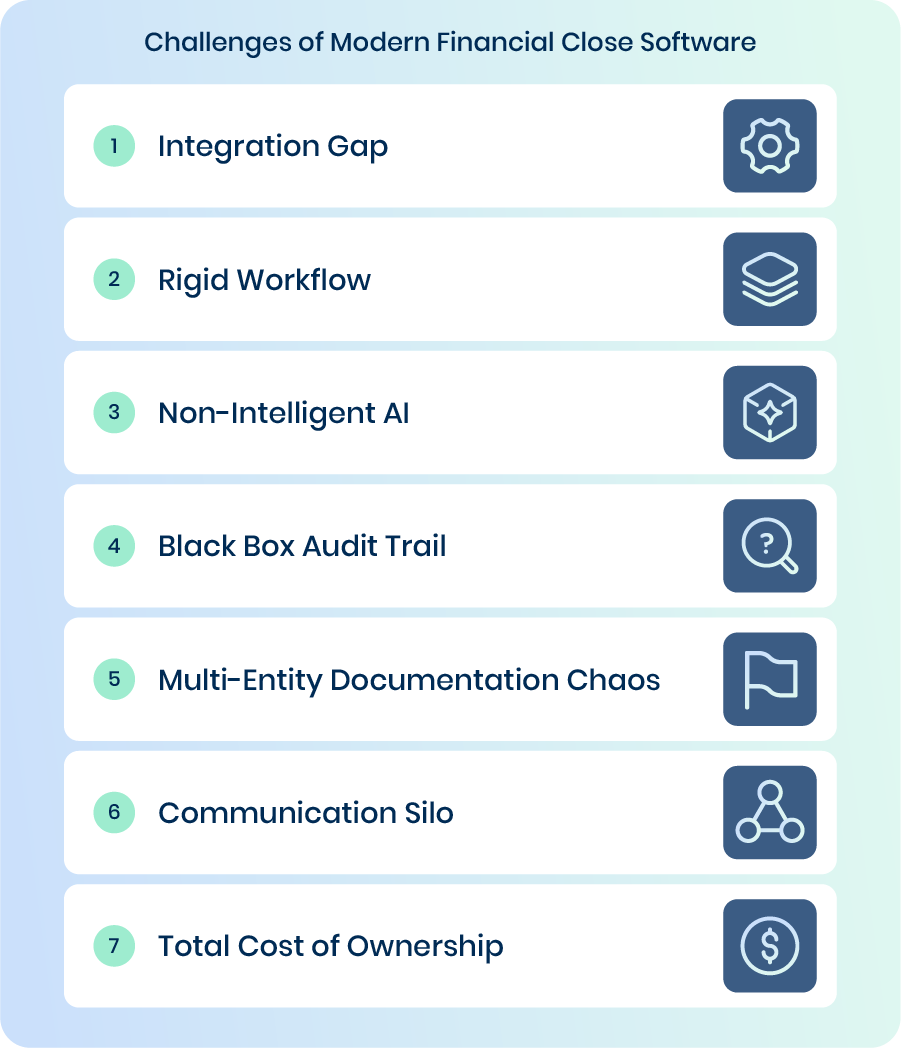
7 Key Challenges of Financial Close Software
- The “Integration Gap”: When Data Doesn’t Flow
- The “Rigid Workflow” Trap
- AI That Is “Artificial” but Not “Intelligent”
- The “Black Box” Audit Trail
- Multi-Entity Documentation Chaos
- The Communication Silo
- High “Total Cost of Ownership”
1) The “Integration Gap”: When Data Doesn’t Flow
The most common frustration with financial close software is the lack of true, real-time synchronization with your ERP. Many close automation vendors claim to “integrate,” but in practice, that often means a “scheduled sync” or, in some cases, a manual flat-file upload.
That gap creates a lag where the finance team is effectively working with yesterday’s numbers, which leads to a constant cycle of manual data validation. Without a continuous stream of information, the software behaves more like a static archive than a dynamic workspace.
The Challenge:
When your close software is not truly unified with your ERP, you end up with two versions of the truth. You might reconcile an account in your close tool, only for a late journal entry to be posted in the ERP, which then renders your reconciliation obsolete. A lack of real-time visibility turns the financial close into a process of chasing moving targets.
How DOKKA Solves It:
DOKKA was built with a “live-link” philosophy. Instead of acting as a separate silo that sits on top of your accounting system, DOKKA integrates deeply with leading ERPs. When a document is captured or a reconciliation is performed in DOKKA, the data is reflected across your ecosystem instantly. That approach eliminates the “double-work” loop that often affects users of older, more fragmented close systems.
2) The “Rigid Workflow” Trap
Many enterprise-level financial close platforms are built on rigid, linear workflows. They assume every company follows a textbook process and often ignore the logistical realities of a growing business. These tools frequently lock teams into “hard-coded” sequences that do not account for the inevitable shifts in priorities or personnel that occur during a high-pressure month-end close.
The Challenge:
Business an be messy. Maybe you need to skip a step one month because of a holiday, or perhaps a specific entity requires a unique approval flow. Many software solutions are so “set in their ways” that even a small deviation requires a support ticket or a consultant to reconfigure the system. That level of rigidity often pushes teams back to spreadsheets just to handle the “exceptions.”
How DOKKA Solves It:
DOKKA is designed for the modern, agile finance team. The platform offers a “flexible-first” architecture. You can manage a single entity or a complex multinational structure with ease, since DOKKA’s approval flows and task management are intuitive and adaptable. It does not force you into a box. Instead, it provides the guardrails you need while still allowing the professional judgment your team is trusted to apply.
3) AI That Is “Artificial” but Not “Intelligent”
“AI-powered” has become a buzzword that almost every software vendor puts on their homepage. However, in the context of financial close software, many tools rely on basic OCR (Optical Character Recognition) and label it as AI. That distinction matters because simple OCR only “sees” characters on a page without understanding what they represent within the context of a general ledger.
The Challenge:
If your software regularly misreads dates, misses line items, or fails to “learn” your recurring vendors, it is not saving you time, it is creating an audit trail of errors you have to fix. Most close tools still require significant manual intervention to map data correctly, which means your senior accountants are effectively doing data entry, just within a more polished interface.
How DOKKA Solves It:
DOKKA’s AI sits at the core of the platform rather than being an added feature. It uses proprietary machine learning to understand the context of financial documents. It does not just read numbers, it interprets the relationship between invoices, POs, and bank statements. Over time, DOKKA learns your specific accounting logic, so the more you use it, the more “invisible” the close process becomes. That is why DOKKA is consistently rated as a leader in AI-driven financial automation on G2 platform.
4) The “Black Box” Audit Trail
In an era of increasing regulation and scrutiny, the “how” and “why” behind every transaction are just as important as the numbers themselves. Many platforms store data and documents in separate “buckets,” which makes it nearly impossible to trace the lifecycle of a transaction without significant manual effort. That lack of transparency turns every internal or external audit into a high-stress scavenger hunt for supporting files.
The Challenge:
Many financial close tools make it difficult to drill down into the source documentation. When an auditor asks for supporting evidence for a year-end accrual, there should be no need to dig through a separate document management system or a physical filing cabinet. In many competing platforms, the “link” between the reconciliation and the source document is weak or does not exist at all.
How DOKKA Solves It:
DOKKA creates a seamless digital audit trail. Every transaction, every reconciliation, and every approval is linked directly to the original source document. A single click allows you, or your auditors, to view the original invoice, the approval history, and the resulting journal entry. That level of transparency reduces audit stress and ensures that your “closing of the books” is supported by solid, verifiable evidence.
5) Multi-Entity Documentation Chaos
For controllers managing multiple subsidiaries, the close software often becomes a labyrinth of switching accounts and re-uploading documents. When software is not designed with a multi-entity architecture from the ground up, it treats each subsidiary as a completely isolated island. Finance teams are forced to duplicate efforts for every intercompany transaction or shared expense.
The Challenge:
Most software requires managing entities in silos. An expense that needs to be split across three entities often forces teams to manually create three separate entries and upload the same document three times. Redundancy creates room for errors, which is why intercompany reconciliations are often the last task completed during the close.
How DOKKA Solves It:
DOKKA is built for multi-entity mastery. Teams can manage documentation and approvals across different branches from a single, unified dashboard. AI identifies which entity a document belongs to, and the Intercompany features ensure both sides of the ledger stay in balance without manual double-entry.
6) The Communication Silo (The “Email Trail” Headache)
The financial close is a team sport, yet most software treats it like a solitary task list. Failing to integrate collaborative tools, these platforms push critical financial discussions into external apps such as Slack, Teams, or old-fashioned email. The result is a “fragmented brain” where the data resides in the software, but the reasoning lives in someone’s inbox.
The Challenge:
When an accountant has a question about a specific invoice during the close, they often have to leave the software to send a message. By the time the auditor arrives six months later, the context of that conversation is gone. The software records the “what,” but not the “why,” leaving the controller to piece together the narrative from memory.
How DOKKA Solves It:
DOKKA includes an integrated chat-on-document feature. Team members can communicate directly on the financial record itself, and all questions, approvals, and clarifications are stored alongside the transaction. This creates a “living history” of the finance department, ensuring that no context is ever lost.
7) High “Total Cost of Ownership”
There is a massive difference between the “sticker price” of software and the actual cost of making it work for your business. Many enterprise close solutions carry a hidden cost in the form of lengthy setup times and the need for specialized administrators. If software requires months of configuration before delivering a single day of value, the ROI of close automation is already compromised.
The Challenge:
Some of the biggest names in the financial close space demand six-month implementation cycles and expensive third-party consultants. For many mid-market companies, the software becomes too complex to fully utilize, resulting in “shelfware” that does not actually speed up the month-end process. Organizations end up paying for enterprise features that the team finds too cumbersome to use.
How DOKKA Solves It:
DOKKA is designed for rapid time-to-value. Its intuitive interface and native integration with existing ERP systems keep the learning curve minimal. Finance teams can complete their first month-end close in DOKKA without needing deep technical expertise. It has become the preferred choice for growing finance teams that need to scale operations without adding massive overhead.
Why DOKKA is the Strategic Choice for Financial Close Automation
When we look at the landscape of financial close software, the “challenges” almost always come down to a lack of empathy for the user. Software developers often build for the “buyer” (the CFO) but overlook the “user” (the Controller and Senior Accountant).
DOKKA bridges that gap. It provides the high-level visibility and “peace of mind” that leadership needs, while also delivering the granular efficiency and ease of use that accounting teams value.
DOKKA does not just manage your close, it accelerates it through the following capabilities:
- Automating Data Entry: Leveraging proprietary AI that does not just “read” but actually understands your invoices and receipts, mapping them to the correct GL codes automatically.
- Streamlining Reconciliations: Deploying automatic matching engines that flag discrepancies in real time, allowing you to fix errors as they occur instead of waiting for day 10 of the close.
- Unifying Documentation: Serving as a centralized, searchable hub where the source document and the accounting data live together permanently, eliminating the need to jump between your ERP and local folders.
- Simplifying Approvals: Providing mobile-friendly, customizable workflows that ensure busy executives can approve transactions on the go, preventing bottlenecked close cycles.
- Centralizing Communication: Replacing fragmented email threads and Slack messages with a chat-on-document feature that keeps the professional context directly tied to the data.
- Ensuring Real-Time Sync: Utilizing a native integration to your ERP, such as NetSuite, or SAP, so your financial close software always stays aligned with your general ledger.
- Advanced Duplicate Detection: Using machine learning to catch double billing or duplicate entries across different entities before they reach your books, helping protect your cash flow.
- Automating the Audit Trail: Generating a fully digital, timestamped history of every change, comment, and approval, making year-end audits a matter of “view access” rather than manual preparation.
- Multi-Currency and Multi-Entity Mastery: Handling complex global structures with ease, enabling document capture and reconciliation across different currencies and legal entities within a single, unified view.
- Smart Reminders and Task Tracking: Automating the reminder process with intelligent notifications that keep the team on schedule without requiring the controller to act as a taskmaster.
The goal of financial close software is to give you time back—time to analyze the numbers, time to partner with the business, and time to actually enjoy your life outside of the office.
If your current software is more “work” than “flow,” it’s time to look at a solution that solves these common challenges. DOKKA was built to turn the financial close from a monthly hurdle into a streamlined, automated, and actually enjoyable process.
Ready to see how DOKKA can transform your month-end? Book a free demo with our team to learn more.