Finance teams are increasingly seeking platforms that do more than just planning and budgeting. Many teams want robust automation for financial close, consolidation, reconciliations, and workflow governance.
While Prophix is known for blending FP&A with close and reporting workflows, some organizations find they require platforms with deeper automation, stronger reconciliation tools, improved audit controls, or more flexible enterprise planning capabilities.
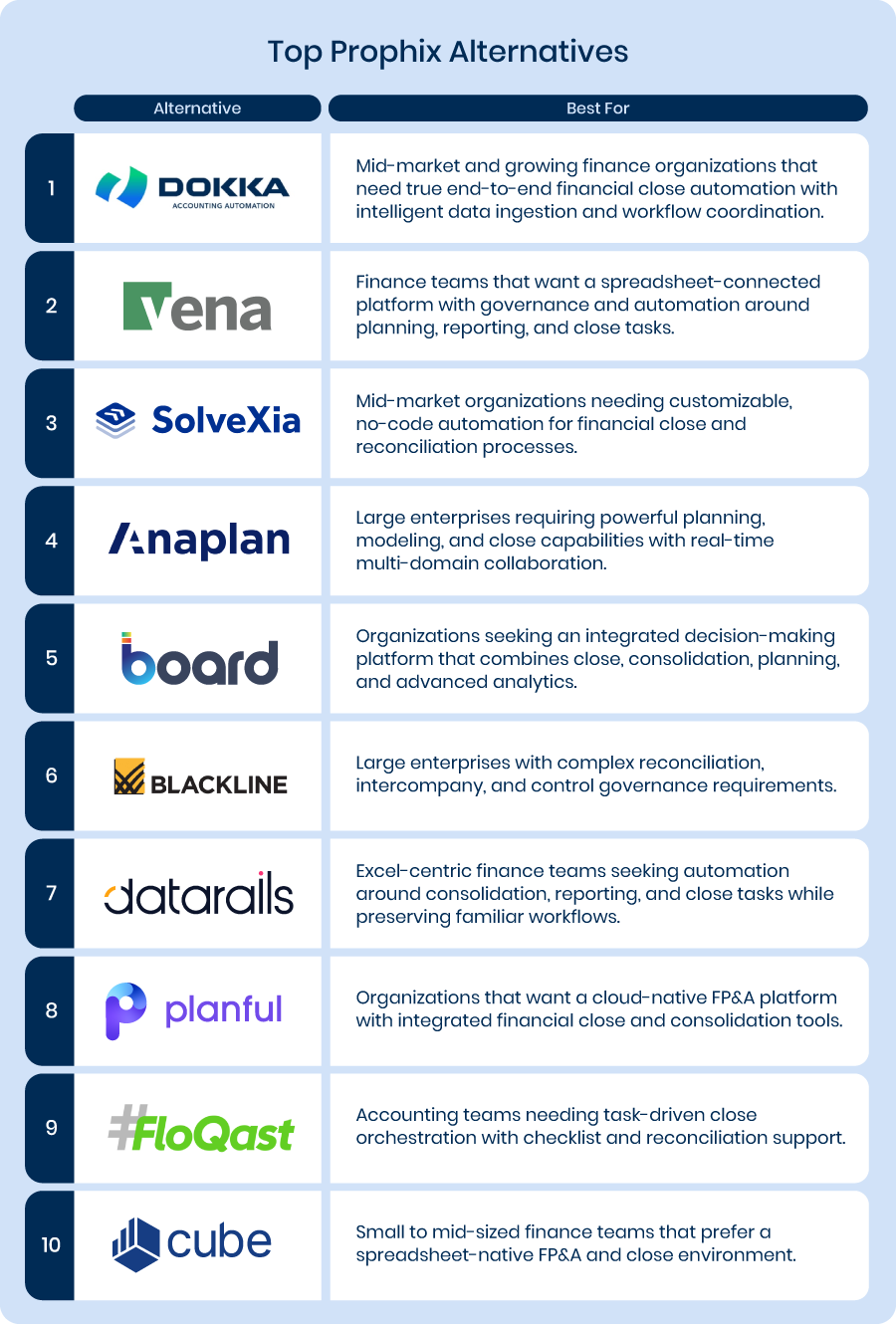
To help you evaluate your options, we have assembled the 10 best Prophix alternatives for financial close automation, spanning modern AI-enabled tools as well as enterprise consolidation and collaborative planning platforms.
10 Best Prophix Alternatives for Financial Close Automation
- DOKKA
- Vena
- Solvexia
- Anaplan
- Board
- Blackline
- Datarails
- Planful
- Floqast
- Cube
1) DOKKA
Best For:
Mid-market and growing finance organizations that need true end-to-end financial close automation with intelligent data ingestion and workflow coordination.
Overview:
DOKKA is a modern financial close automation platform designed to reduce manual effort across reconciliations, journal entry generation, close task tracking, and reporting.
Instead of depending on spreadsheets or semi-manual workflows, DOKKA ingests financial data directly from ERPs and accounting systems, automatically matches transactions, and highlights anomalies. Its real-time dashboards provide visibility across the entire close process and help teams anticipate bottlenecks before they impact deadlines.
Key Features:
- AI-driven reconciliation and automated journal entry creation
- Close checklists with task ownership and auditability
- Seamless ERP integrations for synchronized data flows
- Workflow automation with exception handling and approvals
- Real-time KPI dashboards and exception alerts
Why It’s a Good Alternative to Prophix:
Prophix blends planning and close, but DOKKA deeply automates operational close tasks, particularly reconciliations and data validation, reducing manual intervention and improving accuracy. The platform’s focus on automation rather than spreadsheet-centric workflows helps teams close faster with fewer errors.
Setup Process:
DOKKA typically offers guided onboarding that includes ERP integration, workflow setup, and task configuration. Most teams are operational within weeks, which is significantly faster than many traditional CPM implementations.
G2 Customer Reviews:
Finance teams consistently highlight DOKKA’s intuitive interface, accuracy improvements from AI matching, and dramatic reductions in manual workload during month-end. Reviewers often note improved visibility and faster close cycle times.
2) Vena
Best For:
Finance teams that want a spreadsheet-connected platform with governance and automation around planning, reporting, and close tasks.
Overview:
Vena extends traditional Excel workflows into a centralized and governed system, giving teams the flexibility of spreadsheets with enhanced automation and version control.
It supports budgeting, forecasting, close checklists, and reporting, helping teams maintain familiarity while reducing error risk. The platform integrates directly with various ERP and data sources, centralizing data without abandoning familiar tools.
Key Features:
- Excel-native workflows with centralized governance
- Close and planning checklists
- Reporting and collaboration tools
- Integration with ERP systems and data sources
- Approval workflows for financial activities
Why It’s a Good Alternative to Prophix:
Vena maintains spreadsheet flexibility while adding structured workflows and governance, making it ideal for teams migrating away from manual consolidation while still leveraging Excel for analysis. Compared to Prophix, Vena often feels more familiar to Excel-centric teams.
Setup Process:
Implementation includes building templates and workflows, mapping data connections, and configuring approvals. Vena’s onboarding process is collaborative to fit existing team processes.
G2 Customer Reviews:
Users praise Vena’s balance of control and flexibility, often noting that it democratizes budgeting and close tasks without forcing teams to abandon familiar workflows.
3) Solvexia
Best For:
Mid-market organizations needing customizable, no-code automation for financial close and reconciliation processes.
Overview:
Solvexia is a no-code automation platform that lets finance teams build workflows visually to automate reconciliations, close tasks, and regulatory reporting.
The platform empowers non-technical users to create and adjust processes without heavy IT support, offering flexibility and deep automation for diverse financial scenarios.
Key Features:
- No-code workflow builder for automating financial processes
- Balance sheet reconciliation automation
- Task orchestration and audit documentation
- Template libraries for common close patterns
- Data connectors to multiple ERP and accounting systems
Why It’s a Good Alternative to Prophix:
Solvexia focuses on customizable automation without coding, making it flexible for teams with unique workflows or complex close patterns. Compared with Prophix’s template-based approach, Solvexia supports highly tailored processes that can adapt to evolving close requirements.
Setup Process:
Onboarding involves mapping key processes, building workflows in the visual editor, and connecting data sources. Users typically create productive automation pipelines in significantly less time than coding alternatives.
G2 Customer Reviews:
Customers highlight Solvexia’s ease of use and flexibility, noting that it drastically cuts manual processing time and provides reliable automated workflows aligned with internal controls.
4) Anaplan
Best For:
Large enterprises requiring powerful planning, modeling, and close capabilities with real-time multi-domain collaboration.
Overview:
Anaplan is an enterprise planning platform built on a hyperblock calculation engine that supports complex financial models, scenario planning, and data collaboration across functions.
The platform unifies budgeting, forecasting, and close processes in a single environment, enabling real-time updates and cross-functional planning.
Key Features:
- Hyperblock engine for real-time calculation and modeling
- Scenario and predictive forecasting
- Integrated planning and close workflows
- Collaboration across finance, operations, and business units
- Extensive integration capabilities
Why It’s a Good Alternative to Prophix:
Anaplan is designed for organizations with complex modeling needs and large datasets. Its real-time capabilities and flexibility make it ideal for finance teams that use predictive modeling alongside close and planning functions, offering a more enterprise-grade alternative than Prophix.
Setup Process:
Implementation often involves detailed model building, data integration, and workflow configuration. Anaplan’s professional services and community ecosystem support larger enterprise deployments.
G2 Customer Reviews:
Users emphasize Anaplan’s flexibility and calculation power, especially for multi-scenario planning and large-scale modeling. Many say it fosters cross-functional alignment by breaking down planning silos.
5) Board
Best For:
Organizations seeking an integrated decision-making platform that combines close, consolidation, planning, and advanced analytics.
Overview:
Board is an all-in-one platform covering financial consolidation, budgeting, planning, reporting, and analytics. It enables teams to create interactive dashboards and run scenario analyses alongside their close workflows.
The platform is particularly well suited for companies that need both operational performance and strategic planning capabilities.
Key Features:
- Consolidation and close automation
- Integrated planning and forecasting
- Interactive dashboards and analytics
- Scenario modeling
- Data integration from multiple sources
Why It’s a Good Alternative to Prophix:
Like Prophix, Board spans planning and close, but it emphasizes integrated analytics and decision support. Finance teams needing deeper insights and scenario planning alongside close activities may prefer Board’s visualization and simulation tools.
Setup Process:
Setup typically includes defining integration points, building dimensional models, and configuring dashboards. Board’s toolkit supports iterative rollout of both close and planning workflows.
G2 Customer Reviews:
Users mention Board’s strong analytics capabilities and flexibility, noting that it supports strategic decision making alongside operational tasks.
6) BlackLine
Best For:
Large enterprises with complex reconciliation, intercompany, and control governance requirements.
Overview:
BlackLine is a market-leading financial close automation platform focused on reconciliations, intercompany accounting, journal entry automation, and task orchestration.
The platform provides deep automation that supports detailed accounting control and governance for complex close environments.
Key Features:
- Automated reconciliations and transaction matching
- Intercompany accounting automation
- Journal entry workflows and policy enforcement
- Close task orchestration and monitoring
- Audit trails and compliance dashboards
Why It’s a Good Alternative to Prophix:
While Prophix offers integrated planning and close, BlackLine excels at operational close execution and control governance at scale, especially for enterprises with heavy reconciliation volumes, detailed internal controls, and compliance requirements.
Setup Process:
Implementation includes ERP data mapping, reconciliation rule definition, control configuration, and workflow setup. Larger deployments often leverage dedicated project teams to ensure optimal integration.
G2 Customer Reviews:
Users frequently note BlackLine’s depth of automation and strong controls, highlighting reductions in manual reconciliation workload and improved process consistency.
7) Datarails
Best For:
Excel-centric finance teams seeking automation around consolidation, reporting, and close tasks while preserving familiar workflows.
Overview:
Datarails centralizes financial data while maintaining spreadsheet workflows for reporting and analysis. The platform automates data consolidation and reporting, reducing the friction of manual spreadsheet integration and improving accuracy across close and FP&A processes.
Key Features:
- Centralized FinanceOS for data consolidation
- Automated reporting and dashboards
- Excel integration for familiar workflows
- Scenario modeling and analytics
- Data connectors to ERPs and data sources
Why It’s a Good Alternative to Prophix:
Prophix’s broader planning focus can feel heavyweight for spreadsheet-based teams. Datarails allows finance teams to retain Excel while gaining automation, making it attractive for organizations that want consolidation and reporting without abandoning familiar interfaces.
Setup Process:
Setup involves connecting data sources and configuring consolidation rules, after which teams can begin building automated reporting and analysis workflows.
G2 Customer Reviews:
Reviewers praise Datarails for reducing manual consolidation work and improving analytical insights. Many emphasize that the platform enhances spreadsheet workflows without sacrificing automation.
8) Planful
Best For:
Organizations that want a cloud-native FP&A platform with integrated financial close and consolidation tools.
Overview:
Planful streamlines planning, budgeting, close, and reporting in one cloud platform. The solution supports consolidation and workflow automation and integrates with various ERPs to unify financial data management and processes.
Key Features:
- Financial consolidation and close workflows
- Budgeting, forecasting, and planning
- Continuous reporting and dashboards
- ERP connectivity
- Role-based access and controls
Why It’s a Good Alternative to Prophix:
Since Planful offers similar planning and close automation, it serves as a natural alternative for teams that prefer a broader financial performance platform but want a different user experience or deployment model than Prophix.
Setup Process:
Implementation includes data integrations, consolidation setup, and close workflow configuration. Support resources help ensure teams align the platform with their financial calendar.
G2 Customer Reviews:
Users often highlight Planful’s unified planning and close capabilities, noting its ability to bring budgeting and reporting tasks together in one place.
9) FloQast
Best For:
Accounting teams needing task-driven close orchestration with checklist and reconciliation support.
Overview:
FloQast centralizes close task tracking and reconciliations, helping teams stay organized and accountable during month-end processes. The platform integrates with ERPs and file storage systems, making it more efficient than ad hoc manual checklists.
Key Features:
- Centralized close checklists and task assignment
- Reconciliation tracking and variance dashboards
- Integration with ERP systems
- Audit documentation and close visibility reporting
Why It’s a Good Alternative to Prophix:
If primary close challenges involve task coordination, transparency, and accountability rather than broad forecasting, FloQast offers focused execution capabilities that accelerate month-end workflows in a more purpose-built way than general planning suites.
Setup Process:
Configuration involves defining standard close tasks, linking data sources, and assigning responsibilities. Onboarding typically completes in a few weeks.
G2 Customer Reviews:
Users value the transparency and accountability FloQast provides, with many teams reporting shorter close cycles and clearer ownership.
10) Cube
Best For:
Small to mid-sized finance teams that prefer a spreadsheet-native FP&A and close environment.
Overview:
Cube brings real-time data and automation into spreadsheets like Excel and Google Sheets, enabling reporting, consolidation, scenario analysis, and light close support without abandoning familiar workflows.
The platform syncs with accounting and ERP systems, giving teams a manageable path to automation.
Key Features:
- Spreadsheet-native data synchronization
- Financial reporting and consolidation
- Scenario modeling and KPIs
- ERP and accounting integrations
- Visual dashboards
Why It’s a Good Alternative to Prophix:
Cube is ideal for teams seeking lightweight close support with strong spreadsheet familiarity. The platform is less complex than enterprise CPM solutions but still offers automation and visibility that improve accuracy and reduce manual effort.
Setup Process:
Onboarding includes setting up data connections and configuring models. Many teams begin seeing value within weeks rather than months.
G2 Customer Reviews:
Users highlight Cube’s balance of automation and ease of use. Many appreciate the familiar spreadsheet integration and faster access to consolidated data.
Why DOKKA Is the Best Prophix Alternative
Prophix blends planning, reporting, and financial close, but modern finance teams require automation that directly reduces manual effort during the close cycle, particularly for reconciliations, journal entries, and workflows.
DOKKA delivers end-to-end operational close automation with AI-driven matching and validation, real-time dashboards, seamless ERP integrations, and workflow automation that accelerates month-end while reducing errors.
The platform provides the automation depth teams need without the complexity or extended implementation timelines associated with traditional CPM platforms.
If you want to transform your close cycles and reduce manual work, schedule a demo to see how DOKKA can help.
Disclaimer:
All information presented about third-party products, pricing, or features is based on publicly available sources at the time of writing and is intended for general informational purposes only. DOKKA makes no representations or warranties regarding the accuracy, completeness, or correctness of competitor data. All trademarks and brand names are the property of their respective owners.
We encourage readers to verify details with the respective vendors before making any purchasing decisions.