When organizations first adopt Planful, they often value its unified approach to planning, budgeting, and consolidated financial reporting.
Over time, many finance teams begin looking for alternatives that offer deeper financial close automation, more powerful reconciliation engines, stronger compliance features, or more intuitive workflows that further reduce manual touchpoints.
Whether you are frustrated by spreadsheet dependencies, seeking better reconciliation controls, or simply want a solution more tailored to your close processes, several strong alternatives are worth considering.
In this article we will present the 10 best Planful alternatives for financial close automation, each designed to help teams close the books faster, with greater accuracy and less burnout.
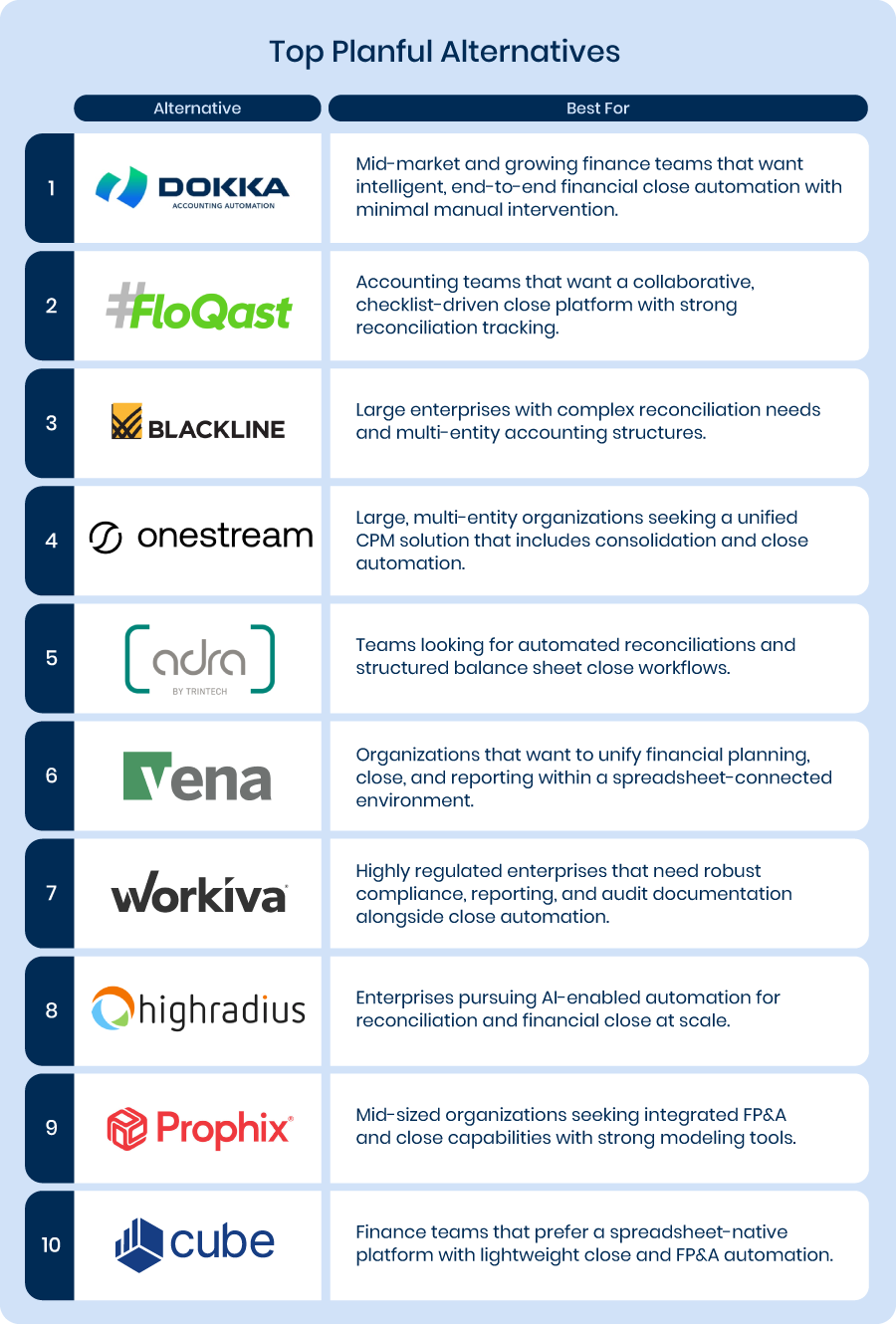
10 Best Planful Alternatives for Financial Close Automation
- DOKKA
- Floqast
- Blackline
- Onestream
- Adra by Trintech
- Vena
- Workiva
- HighRadius
- Prophix
- Cube
1) DOKKA
Best For:
Mid-market and growing finance teams that want intelligent, end-to-end financial close automation with minimal manual intervention.
Overview:
DOKKA provides a modern platform that automates core close processes such as data capture, reconciliations, journal entry support, and task management.
Instead of relying on static spreadsheets, DOKKA ingests data directly from ERP or accounting systems, reducing errors and streamlining month-end close workflows.
Real-time dashboards help finance leaders track close progress, exceptions, and potential bottlenecks before they impact deadlines.
Key Features:
- AI-powered reconciliation and automated journal creation
- Close checklists with task ownership and audit trails
- Rich ERP integrations for synchronized data flows
- Workflow automation with exception handling
- Real-time visual KPIs for close status and trends
Why It’s a Good Alternative to Planful:
Planful is strong in planning and forecasting, while DOKKA focuses on true operational close automation, accelerating reconciliations, task orchestration, and error detection.
For teams that want actionable operational automation rather than consolidated reporting alone, DOKKA delivers faster and more accurate closes with less oversight.
Setup Process:
DOKKA’s onboarding is typically quick and guided. Setup includes ERP integration, workflow and approval configuration, and training for finance users. Most teams see value within just a few weeks.
G2 Customer Reviews:
Users frequently praise DOKKA’s ease of use, automation accuracy, and outstanding customer support. Many finance teams report significant time savings and improved visibility into close cycles.
2) FloQast
Best For:
Accounting teams that want a collaborative, checklist-driven close platform with strong reconciliation tracking.
Overview:
FloQast organizes the close process around tasks and checklists, providing visibility and accountability at every step of the month-end close.
The platform integrates seamlessly with general ledgers and file storage systems, reducing reliance on manual spreadsheets. With reconciliation support and variance tracking, FloQast helps teams maintain control and complete closes faster.
Key Features:
- Centralized close checklists and task tracking
- Reconciliation tracking with variance analysis
- Version control and evidence storage
- Integration with ERPs and file systems
- Progress dashboards and KPIs
Why It’s a Good Alternative to Planful:
Planful combines planning with close tasks, while FloQast focuses on execution excellence for accounting teams. The checklist-oriented approach helps ensure nothing slips through the cracks, and reconciliation tracking adds an extra layer of close accuracy and accountability.
Setup Process:
Implementations typically include mapping existing close tasks, linking accounting data, and configuring team roles. Onboarding is usually completed within a few weeks and includes hands-on support.
G2 Customer Reviews:
Users appreciate FloQast’s collaboration features and its ability to bring structure and transparency to close tasks. Many teams report shorter close cycles and fewer last-minute fire drills.
3) BlackLine
Best For:
Large enterprises with complex reconciliation needs and multi-entity accounting structures.
Overview:
BlackLine is a comprehensive close automation solution that supports account reconciliations, journal entries, task management, and intercompany accounting. Its automation engine handles high volumes of transactions, making it suitable for organizations with expansive financial operations.
The platform also provides detailed audit trails and compliance controls, which are critical for regulated industries.
Key Features:
- Automated reconciliations and transaction matching
- Journal entry workflows and policy enforcement
- Intercompany accounting automation
- Close task orchestration and monitoring
- Audit trails with compliance reporting
Why It’s a Good Alternative to Planful:
BlackLine goes beyond close checklists by offering deep reconciliation engines, intercompany automation, and control governance, which are areas where traditional FP&A tools like Planful typically fall short. Its reconciliation insights and automation can significantly reduce manual work at scale.
Setup Process:
Implementation includes ERP integration, reconciliation rule setup, and configuration of compliance controls. The process generally requires more planning but supports complex close environments effectively.
G2 Customer Reviews:
Reviewers frequently highlight improved accuracy, scalability, and audit readiness. Many note significant reductions in manual reconciliation effort and greater control over multi-entity close processes.
4) OneStream
Best For:
Large, multi-entity organizations seeking a unified CPM solution that includes consolidation and close automation.
Overview:
OneStream’s corporate performance management platform unifies financial consolidation, close, budgeting, planning, and reporting within a single system. It is designed for enterprises that need a consistent control framework across multiple business units and legal entities.
With built-in data quality management and workflow coordination, OneStream supports complex financial environments.
Key Features:
- Multi-entity financial consolidation
- Workflow and task orchestration across close cycles
- Integrated planning, forecasting, and reporting
- Journal entry automation
- Audit trails and compliance dashboards
Why It’s a Good Alternative to Planful:
Planful is a strong plan-and-report platform, but OneStream provides deeper organizational control with tight integration across consolidation and close. Enterprises managing financial processes across geographies or divisions can particularly benefit.
Setup Process:
OneStream implementations typically involve detailed data mapping, entity structure modeling, and workflow design. Given the platform’s breadth, professional services support is often required.
G2 Customer Reviews:
Users highlight OneStream’s consolidation and control capabilities, noting that it reduces reliance on spreadsheets and disparate systems for multi-entity reporting.
5) Adra by Trintech
Best For:
Teams looking for automated reconciliations and structured balance sheet close workflows.
Overview:
Adra focuses on reconciling accounts and managing task workflows during the close. It automates balance sheet reconciliations, flags exceptions, and tracks progress through customizable workflows.
Its modular structure suits mid-sized teams seeking reliable close governance without the complexity of larger enterprise systems.
Key Features:
- Automated balance sheet reconciliation
- Close task tracking and workflow orchestration
- Exception alerts and variance dashboards
- ERP data integrations
- Audit logs and documentation
Why It’s a Good Alternative to Planful:
When reconciliation backlogs and inconsistent close processes are the main bottlenecks rather than planning, Adra delivers structured close management and control. It complements reporting tools and addresses reconciliation gaps often found in broader FP&A suites like Planful.
Setup Process:
Onboarding includes defining account mappings, creating templates for reconciliation tasks, and configuring workflows. Adra’s support team helps align processes with your accounting controls.
G2 Customer Reviews:
Users frequently praise Adra for reducing reconciliation times and improving audit confidence. Many highlight better task visibility and fewer manual reconciliation errors.
6) Vena
Best For:
Organizations that want to unify financial planning, close, and reporting within a spreadsheet-connected environment.
Overview:
Vena extends spreadsheet familiarity through centralized governance and workflow automation. It supports planning, reporting, and basic close tasks such as checklists and approvals, making it a smooth transition for teams moving from manual spreadsheet processes.
Key Features:
- Excel-native interface with centralized data
- Close checklists and collaboration
- Reporting and planning modules
- Workflow automation with approvals
- ERP and accounting system integration
Why It’s a Good Alternative to Planful:
Vena shares many FP&A strengths with Planful while adding workflow governance and stronger integration with spreadsheet-based tasks. It suits finance teams that want planning, close, and reporting in a single, familiar interface.
Setup Process:
Deployment emphasizes building templates, connecting data sources, and configuring workflows. Training ensures teams can take full advantage of both automation and spreadsheet formats.
G2 Customer Reviews:
Reviewers highlight ease of adoption and reduced reliance on manual spreadsheet integration. Many also note improved collaboration between planning and close teams.
7) Workiva
Best For:
Highly regulated enterprises that need robust compliance, reporting, and audit documentation alongside close automation.
Overview:
Workiva is designed for connected financial and regulatory reporting. It enables users to link data from ERPs, GLs, and other systems into a controlled reporting environment with full traceability.
Teams can collaborate in real time, while the platform maintains version histories and embedded workflows.
Key Features:
- Connected reporting and data linking
- Compliance and audit documentation support
- Workflow and version control tools
- Close task tracking and reporting
- Integration with multiple data sources
Why It’s a Good Alternative to Planful:
Planful provides strong planning and budgeting tools, but Workiva excels in reporting continuity and compliance. Teams that must adhere to rigorous standards, such as public companies or regulated entities, often prefer Workiva for its transparency and audit readiness.
Setup Process:
Onboarding involves linking source systems, configuring reports, and establishing collaborative workflows. Workiva’s services team often supports complex compliance configurations.
G2 Customer Reviews:
Users highlight Workiva’s reporting traceability, version control, and audit-friendly features. Many report that it reduces reporting risk in regulated environments.
8) HighRadius
Best For:
Enterprises pursuing AI-enabled automation for reconciliation and financial close at scale.
Overview:
HighRadius provides an AI-driven close automation suite, including automated reconciliations, matching engines, anomaly detection, and workflow orchestration.
Its advanced automation capabilities help finance teams reduce cycle times and free staff from repetitive tasks.
Key Features:
- AI-based reconciliation and matching
- Automated journal entry generation
- Exception and anomaly alerts
- Workflow orchestration across close tasks
- ERP integrations
Why It’s a Good Alternative to Planful:
Planful focuses on planning and reporting, while HighRadius emphasizes intelligent automation for the operational close, including predictive anomaly identification and auto-match reconciliation. In high-volume environments, this approach delivers significant improvements in speed and accuracy.
Setup Process:
Implementation includes ERP connectivity, rule configuration, and AI model training. HighRadius teams frequently assist with onboarding optimizations.
G2 Customer Reviews:
Reviewers report dramatic reductions in manual matching and reconciliation time, along with greater confidence in automated outcomes.
9) Prophix
Best For:
Mid-sized organizations seeking integrated FP&A and close capabilities with strong modeling tools.
Overview:
Prophix provides budgeting, forecasting, financial consolidation, and close automation. Its modeling and scenario planning tools help teams evaluate “what-if” scenarios, while the consolidation engine handles many close tasks.
Key Features:
- Consolidation and close workflow support
- Budgeting and forecasting
- Scenario planning and driver-based modeling
- Reporting dashboards
- Integration with ERP and GL systems
Why It’s a Good Alternative to Planful:
Prophix combines planning and close in a single platform similar to Planful, offering richer modeling tools and consolidation support. It suits teams that need both analytical power and close automation.
Setup Process:
Onboarding includes model setup, data integrations, and workflow design. Training helps users leverage modeling and consolidation together effectively.
G2 Customer Reviews:
Users highlight Prophix’s flexible modeling and ease of use compared to legacy tools. Many report improved planning integration and faster close cycles.
10) Cube
Best For:
Finance teams that prefer a spreadsheet-native platform with lightweight close and FP&A automation.
Overview:
Cube is a spreadsheet-first platform that syncs real financial data into Excel and Google Sheets while providing centralized modelling, consolidation, and reporting. It combines the familiarity of spreadsheets with the automation of a modern FP&A tool, making it a compelling choice for smaller teams.
Key Features:
- Real-time data sync into spreadsheets
- Consolidation and close reporting
- Driver-based planning and forecasting
- ERP and accounting integrations
- Scenario analysis and visualization tools
Why It’s a Good Alternative to Planful:
Cube offers a nimble, user-friendly alternative for teams that want automation without complex systems. While not as robust as enterprise CPMs, it provides powerful spreadsheet-based workflows with reliable data integrity.
Setup Process:
Cube’s onboarding includes data connections and model configuration. Many teams begin seeing results in weeks rather than months.
G2 Customer Reviews:
Users highlight Cube’s ease of setup and lightweight approach, noting reduced spreadsheet errors and faster access to consolidated views.
Why DOKKA Is the Best Planful Alternative
While Planful remains a solid choice for planning, budgeting, and consolidated reporting, modern finance teams increasingly need a platform that automates operational close work, including reconciliations, task orchestration, journal entry support, and exception management, rather than just managing dashboards and planning models.
DOKKA delivers deep automation, AI-powered reconciliation, real-time dashboards, and seamless ERP integration, helping reduce manual effort and accelerate close cycles. Its focus on operational execution makes it an ideal choice for teams seeking both accuracy and speed without heavy technical overhead.
Whether your organization is scaling, facing complex close cycles, or aiming to reduce reliance on spreadsheets, DOKKA provides a smarter, faster way to close the books with confidence.
Want to see DOKKA in action? Book a free demo to learn how it can help your team.
Disclaimer:
All information presented about third-party products, pricing, or features is based on publicly available sources at the time of writing and is intended for general informational purposes only. DOKKA makes no representations or warranties regarding the accuracy, completeness, or correctness of competitor data. All trademarks and brand names are the property of their respective owners.
We encourage readers to verify details with the respective vendors before making any purchasing decisions.