Financial close and reporting are two of the most demanding processes in accounting.
Tight deadlines, heavy documentation, and the risk of errors or compliance issues make them stressful and time-consuming. Many teams turn to specialized software to manage data consolidation, reconciliations, journal entries, and reporting tasks.
Workiva is known for its strong reporting, compliance, and collaborative document-management capabilities, especially when it comes to audit trails, version control, and linked reporting, although it is not always the perfect match for every finance team’s needs due to factors such as complexity, cost, or a preference for more automation over document-centric workflows.
If you are evaluating Workiva but want to explore other financial-close tools that might offer different strengths, such as deeper automation, reconciliation, ERP integration, or simpler setup, here are 9 of the best Workiva alternatives, each suited to different business needs and priorities.
9 Best Workiva Alternatives for Financial Close Automation
- DOKKA
- BlackLine
- FloQast
- Adra by Trintech
- Onestream
- Planful
- HighRadius
- Numeric
- SolveXia
1) DOKKA
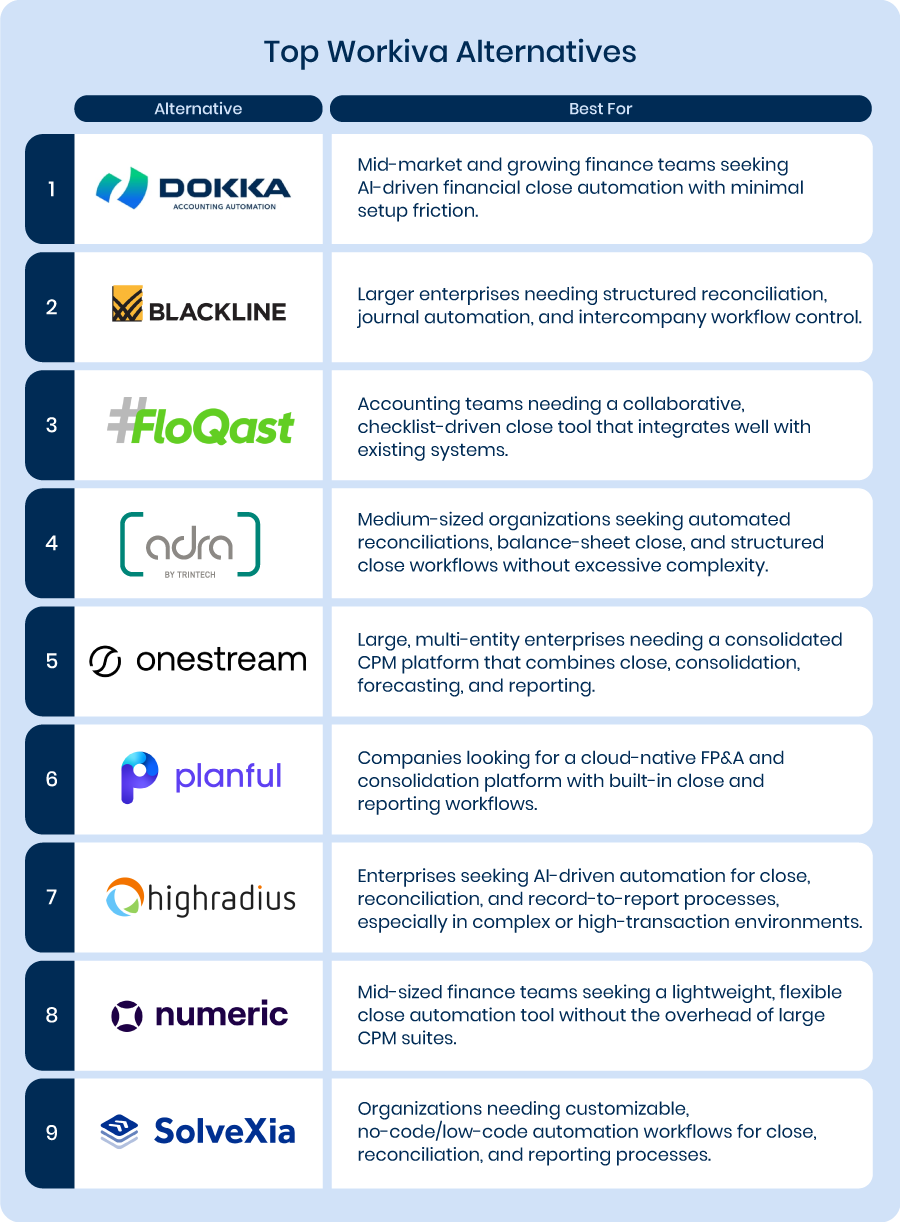
Best For: Mid-market and growing finance teams seeking AI-driven financial close automation with minimal setup friction.
Overview:
DOKKA is designed as a modern financial close platform that automates core processes like data extraction, reconciliations, journal entries, and close task management.
Rather than simply linking data and documents as Workiva does, DOKKA focuses on reducing manual errors and accelerating close cycles. Its cloud-based architecture works with major ERPs to ensure data flows cleanly from source systems to close outputs. Real-time dashboards allow finance leaders to monitor close progress, spot anomalies early, and ensure tasks stay on track.
Key Features:
- AI-powered data extraction and automated reconciliations
- Automated journal entry generation and approval workflows
- Close-checklist and task management with full audit trails
- Seamless ERP integrations for synchronized financial data and consolidated workflows
- Real-time dashboards for close status, exceptions, and actionable insights
Why It’s a Good Alternative to Workiva:
Workiva excels at reporting, compliance and linked documentation, although DOKKA goes deeper on actual close operations.
For teams focused on speeding up close cycles, reducing manual reconciliation effort, and gaining reliable GL-to-close automation, DOKKA delivers more operational automation rather than a document-management emphasis. It is a strong fit for companies that want both automation and flexibility without investing heavily in complex reporting tools they may not need.
Setup Process:
DOKKA typically offers rapid onboarding. ERP integration, data mapping, and workflow configuration often take only a few days to a few weeks, allowing teams to go live quickly.
G2 Customer Reviews:
Users frequently highlight DOKKA’s intuitive interface, AI accuracy, and how much it reduces manual workloads during month-end close. Many mention faster closes, fewer reconciliation issues, and improved visibility supported through dashboard tracking.
2) BlackLine
Best For: Larger enterprises needing structured reconciliation, journal automation, and intercompany workflow control.
Overview:
BlackLine has long been a key player in financial close automation. The platform supports account and transaction reconciliations, journal entry automation, intercompany accounting, and task-driven close workflows.
It gives organizations a standardized and controlled approach to close, enabling better compliance and audit readiness, which is a strength often cited by companies that combine it with reporting tools like Workiva.
Key Features:
- Automated reconciliations and transaction matching
- Journal entry automation and policy controls
- Intercompany accounting automation for multi-entity companies
- Task and close-management workflows with real-time visibility
- Audit-ready documentation and compliance controls
Why It’s a Good Alternative to Workiva:
Workiva offers strong reporting and documentation collaboration, while BlackLine brings deeper operational automation for close, especially reconciliations and intercompany accounting, which are often cumbersome in spreadsheet-based or manual environments.
For organizations struggling with month-end volume, multiple entities, or complex intercompany processes, BlackLine’s automation depth often delivers more efficiency than Workiva alone.
Setup Process:
Implementation involves integrating with ERP ledgers, configuring reconciliation rules and mappings, and defining journal policies. It typically requires coordination between finance and IT but provides strong documentation and internal control features to support compliance and auditability.
G2 Customer Reviews:
Users commonly praise BlackLine for reliability, control over reconciliations, and scalability, especially for large or multi-entity organizations. Many note substantial reductions in manual reconciliations and increased consistency in their close routines.
3) FloQast
Best For: Accounting teams needing a collaborative, checklist-driven close tool that integrates well with existing systems.
Overview:
FloQast enables teams to manage the month-end close using collaborative checklists, task assignments, and reconciliation tracking. It is designed to overlay existing accounting systems and productively replace manual close spreadsheets.
Because it supports integration with ERPs and file storage, teams can retain their current processes while adding structure and automation.
Key Features:
- Close task checklists with assignment and status tracking
- Reconciliation and variance tracking to streamline reconciliations
- Workflow automation for approvals and documentation
- Integration with accounting systems and data sources
- Collaboration tools allowing multiple users to work simultaneously
Why It Is a Good Alternative to Workiva:
FloQast emphasizes close execution rather than document-centric reporting.
Teams that need operational close support, such as reconciliations, close checklists, and variance tracking, but do not require full-fledged reporting or disclosure capabilities, will find FloQast a lighter-weight, purpose-built solution.
The platform is especially effective for mid-sized teams seeking to move away from Excel-based manual closes without overinvesting in heavy reporting suites.
Setup Process:
Onboarding involves linking existing accounting data, defining the close structure including tasks, reconciliations, and approvals, and mapping data flows. Implementation tends to be relatively fast compared with enterprise-grade consolidation tools.
G2 Customer Reviews:
Users frequently highlight reduced close-cycle time, better team collaboration, and clearer accountability. Many note that FloQast replaced complex spreadsheets and confusing email threads with a more organized and transparent process.
4) Adra by Trintech
Best For: Medium-sized organizations seeking automated reconciliations, balance-sheet close, and structured close workflows without excessive complexity.
Overview:
Adra is part of Trintech’s suite of close automation tools. It automates balance-sheet reconciliations, supports variance detection, and provides close-task orchestration to help teams stay organized and audit-ready.
Its modular design adapts to companies that require solid close control without overbearing enterprise overhead.
Key Features:
- Automated balance sheet and account reconciliations with matching and variance detection
- Close task tracking and workflow orchestration for month-end activities
- Audit-ready logs and documentation to support compliance and controls
- Integration with ERP systems and general ledgers for data consistency
Why It’s a Good Alternative to Workiva:
When the primary need is reliable, structured close and reconciliation rather than heavy reporting, disclosures, or complex document workflows, Adra can provide more efficient, streamlined close processes than Workiva’s broader, reporting-centric toolset. It reduces reliance on spreadsheets and improves accuracy in reconciliations and balance sheet management.
Setup Process:
Onboarding typically includes account mapping, template setup for reconciliations, and configuration of workflows and approvals. The process tends to be faster than enterprise consolidation solutions, making it suitable for mid-sized teams.
G2 Customer Reviews:
Users frequently report reductions in close time, fewer errors in balance-sheet reconciliations, and improved audit readiness. Many highlight clear task tracking and ease of use compared with manual reconciliation methods.
5) OneStream
Best For: Large, multi-entity enterprises needing a consolidated CPM platform that combines close, consolidation, forecasting, and reporting.
Overview:
OneStream is a corporate performance management (CPM) suite that supports financial consolidation, close management, budgeting, forecasting, and financial reporting within a single platform. It is designed for organizations with complex structures and multi-entity consolidation needs, offering a unified approach to both close and planning processes.
Key Features:
- Multi-entity consolidation and close automation
- Journal entry automation and transactional data management
- Integrated planning, forecasting, and reporting tools alongside close functionality
- Workflow orchestration and control across consolidation, close, and planning cycles
Why It’s a Good Alternative to Workiva:
Organizations that require more than reporting (those needing consolidation, inter-entity roll-ups, budgeting, and forecasting), will find OneStream offers a broader, integrated finance platform. While Workiva excels at linked reporting and compliance, OneStream provides deep financial control across consolidation and operational close processes, reducing dependence on disparate tools.
Setup Process:
Implementation is typically more involved, often requiring detailed data mapping, entity configuration, consolidation model setup, and user training. The payoff is a powerful all-in-one solution capable of replacing multiple legacy systems.
G2 Customer Reviews:
Users highlight OneStream’s scalability and robustness for complex organizational structures. Many emphasize its ability to handle multi-department and multi-entity consolidations, reducing reliance on multiple systems for banking, reporting, and close.
6) Planful
Best For: Companies looking for a cloud-native FP&A and consolidation platform with built-in close and reporting workflows.
Overview:
Planful provides financial consolidation, close management, forecasting, and reporting within a single cloud-based platform. It offers tools for multi-entity consolidation, orchestration of close workflows, and real-time financial reporting dashboards, helping teams reduce reliance on spreadsheets and manual data consolidation.
Key Features:
- Consolidation and close automation across entities
- Workflow and task management for close cycles and reporting periods
- Forecasting, budgeting, and planning modules integrated with close functionality
- Role-based dashboards and real-time financial reporting views
Why It’s a Good Alternative to Workiva:
For organizations that prioritize integrated FP&A, consolidation, and close rather than purely document-centric reporting, Planful delivers a unified platform covering similar capabilities to OneStream with potentially simpler implementation. Compared to Workiva, Planful combines planning, close, and reporting in a single environment.
Setup Process:
Onboarding includes consolidation model configuration, task workflow design, data integration, and initial training. Many companies report faster go-live times compared to enterprise-level CPM platforms.
G2 Customer Reviews:
Users frequently emphasize Planful’s flexibility, consolidation capabilities, and ability to unify FP&A, close, and reporting, helping reduce errors and simplify month-end processes.
7) HighRadius
Best For: Enterprises seeking AI-driven automation for close, reconciliation, and record-to-report processes, especially in complex or high-transaction environments.
Overview:
HighRadius offers an AI-powered close automation platform that includes automated reconciliations, journal entries, transaction matching, and anomaly detection. It is designed to handle high-volume data and complex workflows, making it a strong option for companies with large transaction volumes, multiple entities, or diverse data sources.
Key Features:
- AI-based reconciliation and transaction matching with high auto-match rates
- Automated journal entry generation and posting based on intelligent rules
- Exception detection and anomaly alerts to catch discrepancies proactively
- Workflow automation for close tasks and collaboration across teams
Why It Is a Good Alternative to Workiva:
Workiva excels at reporting and compliance, while HighRadius emphasizes automation and efficiency in the close and record-to-report cycle itself. Organizations handling large volumes, multiple subsidiaries, or frequent transactions can benefit from the AI automation and error detection in HighRadius, which can significantly accelerate close cycles and improve accuracy.
Setup Process:
Implementation requires ERP integration, rule configuration, and AI model setup. The process is generally more involved than simpler tools, but the time savings on reconciliation and close tasks often justify the effort.
G2 Customer Reviews:
Users frequently report dramatic reductions in manual transaction matching, faster close cycles, and improved reliability. Many highlight the AI-matching accuracy and the reduction of reconciliation backlog.
8) Numeric
Best For: Mid-sized finance teams seeking a lightweight, flexible close automation tool without the overhead of large CPM suites.
Overview:
Numeric positions itself as a modern alternative to legacy close software, offering streamlined close task management, reconciliation support, and automation tools that integrate with existing accounting systems. It is designed for teams looking to transition away from manual spreadsheet-based closes without diving into heavy enterprise platforms.
Key Features:
- Reconciliation automation and matching features for balance sheet close
- Close task and checklist management for monthly and quarterly close workflows
- Dashboard visibility into close status, pending tasks, and reconciliation progress
- Flexibility to integrate with ERPs and accounting systems without heavy infrastructure requirements
Why It Is a Good Alternative to Workiva:
Numeric provides a simpler, more agile option compared to Workiva’s extensive document and reporting platform. Finance teams primarily focused on reconciling accounts, closing books, and managing tasks (rather than extensive reporting or compliance) may find that Numeric delivers most of what they need with less complexity and lower cost.
Setup Process:
Onboarding is typically fast and flexible, with integration options and workflow configurations tailored to mid-sized teams. Numeric’s lighter footprint often requires less IT involvement compared to large CPM tools.
G2 Customer Reviews:
Users value Numeric’s simplicity, ease of setup, and clear dashboards. Many note improved close visibility and greater control over reconciliation tasks without the overhead of more complex systems.
9) SolveXia
Best For: Organizations needing customizable, no-code/low-code automation workflows for close, reconciliation, and reporting processes.
Overview:
SolveXia offers a flexible automation platform that can be configured to automate various financial processes, including reconciliations, transaction matching, custom close workflows, and report generation.
Its no-code/low-code approach allows finance teams to build and modify processes without heavy IT dependency, providing agility in adapting to changing accounting and reporting needs.
Key Features:
- Customizable workflow automation for close, reconciliation, and reporting tasks
- Data integration from multiple sources, enabling consolidated financial views
- Audit-ready logs and documentation to support compliance and internal controls
- Flexibility to build tailored scripts or flows for complex or non-standard processes
Why It Is a Good Alternative to Workiva:
Workiva emphasizes connected reporting and compliance, while SolveXia focuses on customizable automation. Organizations with unique workflows, unusual reporting needs, or requirements for flexibility beyond standard close patterns can use SolveXia to automate and adapt processes without committing to rigid templates.
Setup Process:
Onboarding involves defining process flows, connecting data sources, and configuring automation rules. The no-code/low-code design makes it accessible to finance teams without deep IT skills, and adjustments can be made as requirements evolve.
G2 Customer Reviews:
Users praise SolveXia for its adaptability and its ability to automate previously manual or ad-hoc processes. Many note that it handles complexity effectively without requiring full-scale enterprise systems.
Why DOKKA Is the Best Workiva Alternative
When choosing an alternative to Workiva, many finance teams face a trade-off: either heavy reporting and documentation tools or operational automation.
DOKKA bridges that gap, offering powerful automation for reconciliations, journal entries, close tasks, and data integration, while still providing the speed, flexibility, and ease of use that modern finance departments require.
Unlike Workiva’s document-centric model, DOKKA emphasizes operational efficiency, error reduction, and ERP-driven close automation.
Teams looking to shorten close cycles, reduce manual reconciliation work, and implement reliable workflows with minimal setup will find tangible performance improvements with DOKKA. It is a strong fit for mid-sized and fast-growing businesses seeking enterprise-grade close automation without overly complex reporting layers.
Finance teams can explore how DOKKA transforms the close process, from data ingestion to final close, by scheduling a demo to see how it compares with Workiva and other close automation solutions.
Disclaimer:
All information presented about third-party products, pricing, or features is based on publicly available sources at the time of writing and is intended for general informational purposes only. DOKKA makes no representations or warranties regarding the accuracy, completeness, or currentness of competitor data. All trademarks and brand names are the property of their respective owners.
We encourage readers to verify details with the respective vendors before making any purchasing decisions.